
Introduction
For engineers designing fluid delivery systems for industrial equipment, automotive thermal management, medical devices, home appliances, or consumer electronics, choosing between a BLDC pump and a brushed DC pump is one of the most impactful technical decisions. It directly affects product reliability, power consumption, noise level, maintenance cost, and overall user experience. Although both types use DC motors to drive fluid flow, their internal structures, commutation methods, and performance characteristics are fundamentally different.
This article provides a practical, engineering-focused comparison based on real working conditions and application scenarios, rather than empty marketing language. We use measurable parameters and real industry examples to help you decide which pump fits your project.
Core Working Principle
The key difference between BLDC and brushed pumps is their commutation method.
A brushed pump uses mechanical commutation. Carbon brushes press against a rotating commutator to switch current direction in the motor windings. This structure is simple and low-cost, but physical contact causes unavoidable friction and wear.
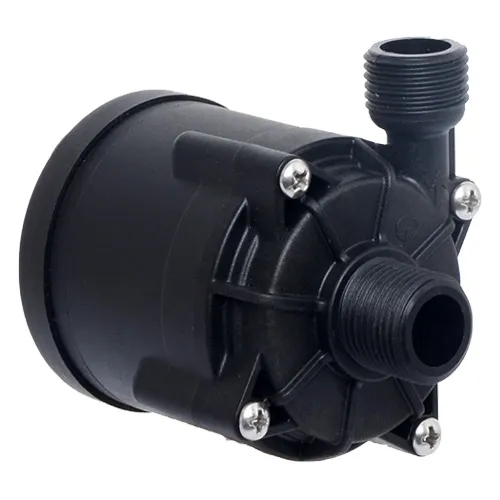
A BLDC (Brushless DC) pump uses electronic commutation. A dedicated driver circuit controls the stator windings, and permanent magnets on the rotor create rotation without any physical contact. This eliminates the main wear point in brushed motors. For liquid cooling and water circulation applications, you can refer to our dedicated BLDC water pump product page for detailed specifications and application data.
Service Life & Reliability
Brushed pumps depend on carbon brushes that gradually wear out during operation. Under continuous use, their typical lifespan is 1,500–3,000 hours. As brushes wear down, they produce carbon dust that can contaminate bearings or fluid channels, leading to early failure. This makes brushed pumps unsuitable for long-term continuous operation.
Real application example:
Low-cost desktop water fountains, temporary watering devices, and short-term experimental fluid setups, where the pump runs occasionally and replacement is low-cost.
BLDC pumps have no brushes or commutator, so only the bearings are considered wearable parts. Well-designed BLDC pumps can easily reach 30,000 hours or more of continuous service. Most are fully sealed and maintenance-free, ideal for equipment that runs 24/7.
Real application example:
Server liquid cooling systems, electric vehicle battery thermal management, industrial circulating water systems, and outdoor monitoring equipment where maintenance access is limited.
Energy Efficiency
Efficiency directly determines power consumption and heat generation.
Brushed pumps lose significant energy to friction and electrical arcing. Their typical efficiency ranges from 40%–60%. Much of the input power becomes waste heat, increasing thermal load and shortening battery life in portable devices.
Real application example:
Real application example:
Solar-powered water circulation systems, portable medical devices, remote agricultural monitoring equipment, and battery-powered outdoor appliances where energy efficiency directly affects working time.
Noise & Vibration
Brushed pumps produce obvious noise and vibration due to mechanical contact and commutation arcing. Their operating noise is usually 55–70 dB, which can be disruptive in quiet environments. Excessive vibration also increases stress on pipes and connectors.
Real application example:
Industrial workshop fluid transfer tools, construction site small pumps, and low-cost agricultural equipment where noise is not a primary concern.
BLDC pumps run much smoother with minimal torque ripple. Most models operate below 40 dB, some brushless dc pumps used for home application which required quiet working noise even lower than 25 dB, making them suitable for noise-sensitive environments. Lower vibration also improves overall system stability.
Real application example:
Medical ventilators, home smart water heaters, aquarium circulation pumps, bedroom humidifiers, and office cooling equipment where quiet operation is required.
Control Precision & Responsiveness
Brushed pumps only support basic on/off control. Speed adjustment using external resistors is inefficient and inaccurate, with no speed feedback. They cannot maintain stable flow or pressure under changing loads.
Real application example:
Simple water dispensers, basic garden sprayers, low-cost fluid filling machines, and small DIY fluid projects with no precision requirements.
BLDC pumps support PWM speed control, 0–5V analog adjustment, and closed-loop control with FG feedback signals. Engineers can accurately regulate flow rate and pressure to meet system demands.
Real application example:
Medical infusion pumps, semiconductor cooling systems, automated production line fluid delivery, laboratory analytical instruments, and precision circulation equipment where flow stability is critical.
Cost & System Complexity
Brushed pumps have a clear advantage in upfront cost. They require no driver circuit, have a simple structure, and low component count. This reduces BOM cost and development time, making them ideal for budget-sensitive products.
Real application example:
Disposable medical devices, low-cost consumer gadgets, short-term promotional pumps, and low-end household appliances.
BLDC pumps have higher initial cost due to the driver IC and more complex components. However, longer lifespan, lower maintenance, and higher efficiency result in a lower total cost of ownership over the product lifecycle.
Real application example:
Commercial HVAC systems, automotive thermal management, industrial IoT equipment, high-end home appliances, and professional cooling systems.
Application Selection Guide
Choose Brushed Pumps If:
- Your project has a very tight upfront budget
- The pump runs intermittently with low total operating hours
- Only basic on/off control is needed
- The product is disposable or short-term use
Typical applications:
Disposable fluid injectors, temporary garden sprayers, low-cost small water fountains, workshop oil transfer tools.
Choose BLDC Pumps If:
- The system requires 24/7 continuous operation
- High efficiency and low power consumption are critical
- Low noise and vibration are required
- Precise flow or speed control is necessary
- Maintenance access is limited
Typical applications:
Electric vehicle cooling systems, medical infusion pumps, server liquid cooling, solar water circulation, smart home constant-temperature appliances.
Conclusion
BLDC pumps outperform brushed pumps in lifespan, efficiency, noise, and control accuracy. They are the better choice for professional, long-life, and high-reliability applications. Brushed pumps remain a practical solution for low-cost, simple, and short-duration use cases.
The final decision should be based on your actual working conditions, performance requirements, and budget. For most industrial, automotive, and high-end consumer fluid systems, BLDC pumps provide better long-term value and stability. For low-cost, short-term, or low-demand projects, brushed pumps can still be a reasonable choice.