
Introduction
Fluid circulation systems serve as the lifeline of countless modern devices and industrial setups, from electric vehicle thermal management to precision cooling for laser and manufacturing equipment. For decades, engineers have relied on conventional brushed water pumps to meet basic circulation needs, yet these units consistently fall short in terms of service life, energy efficiency, and long‑term reliability. As industrial standards grow stricter and energy conservation becomes a global priority, a more advanced solution has taken the lead: the BLDC water pump. In this article, we explain the core definition, internal structure, and operating logic of a BLDC water pump from a practical engineering perspective, helping you fully understand how this technology works and why it has become the preferred choice for professional cooling and fluid delivery systems.
What Is a BLDC Water Pump and How Does It Work?
A Brushless Direct Current (BLDC) water pump is a high-performance fluid circulation device that replaces the mechanical commutation system found in traditional brushed DC pumps with electronic control. By removing carbon brushes and physical commutators—two of the most failure-prone parts in conventional pumps—BLDC water pumps achieve far better stability, efficiency, and service life for modern thermal management, liquid transfer, and circulation systems. Designed for continuous duty in demanding environments, these pumps have become standard in electric vehicle cooling, industrial machinery, laser equipment, and household appliances where reliability and low maintenance are non‑negotiable engineering requirements.
For a full range of application-specific BLDC water pump solutions, you can refer to our product lineup here: BLDC water pump.
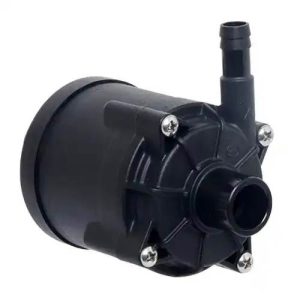
At its core, a BLDC water pump consists of a permanent magnet rotor, stator coil assembly, high-precision bearings, centrifugal impeller, sealed pump housing, and an integrated electronic driver. Most industrial-grade models use ceramic shafts and bearings to minimize friction, while the rotor is fitted with high‑grade permanent magnets to maintain strong magnetic performance under varying temperatures. In practical assembly, we always ensure the magnet material matches the operating temperature range to avoid thermal demagnetization, a detail easily overlooked in low-cost pumps. The electronic driver acts as the control unit, detecting rotor position in real time, usually through Hall sensors or sensorless control algorithms, and energizes the stator coils in a precise sequence to generate a smooth rotating magnetic field. This contactless drive mechanism eliminates sparking, mechanical wear, and electrical noise—common drawbacks of brushed pump designs.
The operating principle of a BLDC water pump combines electromagnetic drive and centrifugal fluid mechanics, and it follows a clear, repeatable cycle in real‑world use. Before startup, the pump chamber must be fully primed to remove air pockets; trapped air will cause cavitation over time and reduce impeller and bearing life. Once powered, the electronic controller sends modulated current to the stator coils, creating a rotating magnetic field that exerts torque on the permanent magnet rotor. As the rotor spins, the attached impeller generates centrifugal force that pushes liquid toward the outer diameter, increasing flow velocity. The volute casing then converts kinetic energy into static pressure, pushing fluid through the outlet port. This continuous cycle creates stable flow and head pressure, with the low-pressure zone at the impeller center constantly drawing in new liquid to maintain circulation.
One major engineering advantage of BLDC water pumps is their precise variable speed control, typically achieved through PWM (Pulse Width Modulation) signals. Unlike fixed-speed brushed pumps, BLDC models can adjust speed dynamically to match system load, which significantly improves part-load efficiency and reduces unnecessary power consumption. Most reliable BLDC pumps reach 85% to 92% efficiency, far exceeding that of traditional DC or AC pumps. This level of controllability makes them ideal for closed-loop cooling systems where temperature stability directly affects equipment performance and lifespan.
Longevity and durability further separate BLDC pumps from conventional alternatives. Without brush wear, a properly designed BLDC water pump can easily reach 30,000 operating hours or more—five to ten times longer than a brushed pump. The fully sealed structure also provides excellent protection against moisture, dust, and light corrosion, allowing stable operation in harsh industrial settings. For applications requiring quiet operation, low vibration, and consistent performance, BLDC technology is often the only practical long-term solution.
While this article covers the fundamentals of BLDC water pumps, there are many deeper technical considerations for design, selection, installation, and troubleshooting. These include bearing types, material compatibility, dry-run protection, wiring standards, and performance curve matching.
For a complete technical reference covering all these topics, you can explore our comprehensive brushless DC pump ultimate guide here: brushless DC pump ultimate guide.
BLDC water pump represents a mature, reliable upgrade over traditional fluid transfer solutions. It solves the historical pain points of brushed pumps while delivering higher efficiency, better controllability, and lower total cost of ownership. As industries continue to push for energy savings and reduced maintenance, BLDC water pumps will remain a foundational component in modern fluid systems.